Paper releases

Paper

EgoUseBench: Yurun Chen et al. release a benchmark for computer-use agents with first-person context

EgoUseBench tests whether computer-use agents can act on tasks grounded in first-person views from wearables like smart glasses, as the user's intent and observations change. It has 693 tasks built from over 74 hours of real-world first-person recordings. Average success in the Online Ego Use setting is 26.3% lower than in standard Computer-Use.
Paper

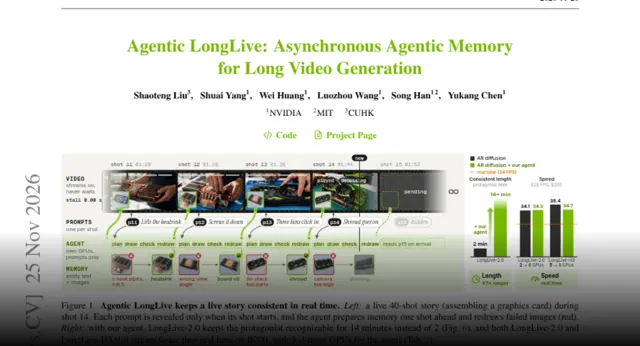
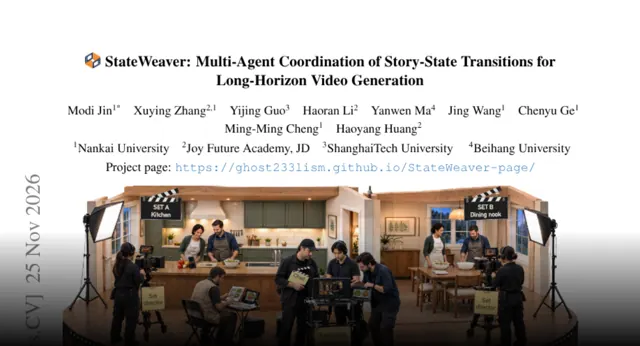
Modi Jin et al. release StateWeaver, multi-agent framework for consistent long video generation

StateWeaver is a multi-agent framework that helps video generation models keep characters and story details consistent across shots in long videos. It combines Active States with Hierarchical Collaboration to update visual references and pass state between shots. The authors report it outperforms existing methods across multiple benchmarks.

Paper

Stable Gated DeltaNet-2: Xichong Zhang et al. fix recurrent state instability in linear attention

Stable GDN-2 is a modification of Gated DeltaNet-2 that addresses training failures in long-context linear attention models. It uses symmetric erasure and decay-regulated residual writing to keep the recurrent state from growing exponentially. On ~1.6B parameter models it trains stably and improves long-context retrieval.

Paper

ProxyGenBench: a benchmark for proxy-guided video generation, from Zhenchen Tang et al.

ProxyGenBench is a benchmark that tests how well video generators follow structural proxies such as animated 3D blockouts. It has 312 evaluation cases from 60 scenes, with controlled changes in proxy fidelity, text detail and multimodal inputs. Tests on five generators show proxies improve spatiotemporal control, but strong structural adherence does not ensure correct binding.

Paper

Arya Sikder releases Vernier, a tool for measuring resolution of time-series forecasting leaderboards

Vernier computes the resolution of a forecasting leaderboard, meaning the smallest score difference its datasets can detect, using files the board already publishes. It also reports which entries cannot be separated from the leader and whether rankings shift when other parties submit. It is aimed at people who rely on zero-shot time-series leaderboards.

Paper

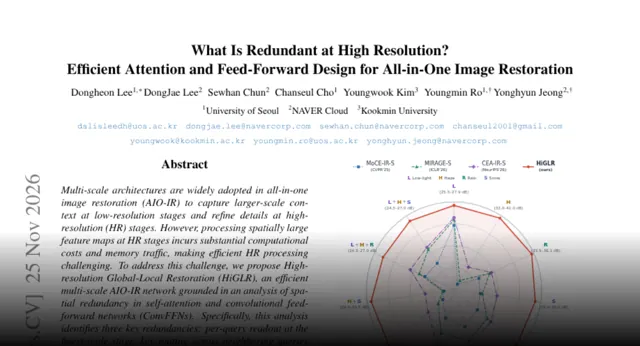
HiGLR: efficient all-in-one image restoration network from Dongheon Lee and colleagues

HiGLR is a 7M-parameter multi-scale network for all-in-one image restoration, built by cutting redundant computation at high resolution. It replaces or restructures self-attention and convolutional feed-forward layers in different stages. The authors report state-of-the-art results on three benchmarks with faster inference and lower peak GPU memory than CEA-IR-S.

Paper

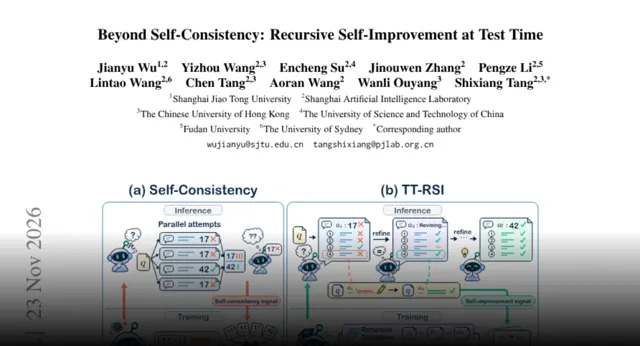
Jianyu Wu releases TT-RSI, a test-time method where LLMs refine their own earlier solutions

TT-RSI (Test-Time Recursive Self-Improvement) lets a language model build on its own previous attempts instead of voting among independent answers. It works without labels, either at inference or through test-time training. The paper reports +13.89% average accuracy over the base model and +4.79% over TTPO + SC at the same test-time budget.

Paper

Zishan Qin et al. release Target-Part Preference Optimization (PartDPO) for part-aware 3D generation

PartDPO is a preference fine-tuning method that adapts a pretrained part-aware 3D generator using limited part-annotated data, with no architecture changes. It learns preferences over individual parts while keeping geometric supervision. A medium-scale training set gave the best multi-part results on held-out Objaverse, though gains were less consistent under distribution shift.

Paper

AIRIS: Yuchen Zhou et al. release streaming benchmark for social embodied intelligence

AIRIS is a benchmark that tests how models handle social situations in egocentric streaming video, where they see only the footage available at each query time. It frames the task as a chain of Attention, Intention, Reaction, and Interaction. Tests of 45 models show they often guess intent too early and struggle to align timing, action, and execution.

Paper

Real2SimLab: unified platform for real-to-simulation transfer, from Yongchang Zhang et al.

Real2SimLab is a platform for evaluating methods that build simulations from real-world observations such as video recordings. Existing benchmarks each define their own inputs, deliverables and scoring, so testing N methods on M benchmarks needs N times M integrations. Real2SimLab is meant to unify this for researchers working on real-to-simulation transfer.

Paper

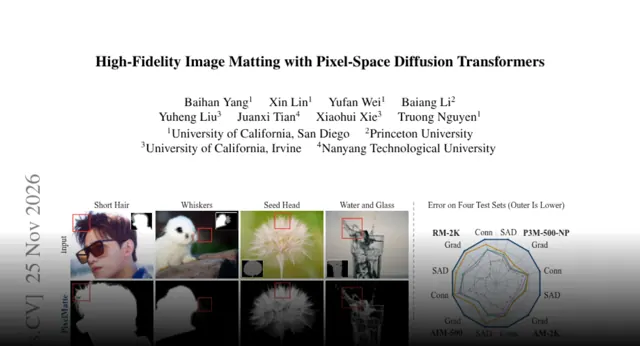
Baihan Yang et al. release PixelMatte, image matting with pixel-space diffusion transformers

PixelMatte adapts pretrained pixel-space diffusion transformers to predict alpha mattes for image matting, avoiding the compression of latent diffusion models. It predicts mattes in a single forward pass and works even from a text-to-image-only backbone. The authors report 24-44% lower SAD and gradient errors than RenderMatte on P3M-500-NP.

Paper

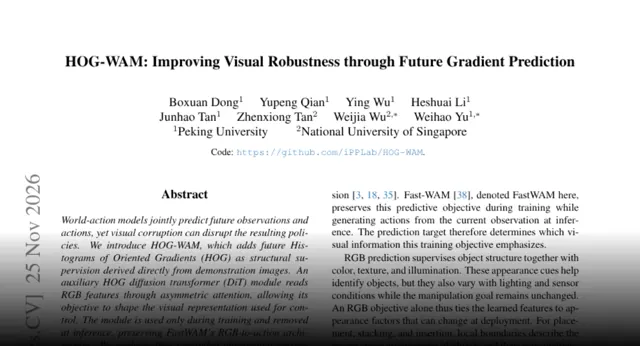
HOG-WAM: Boxuan Dong et al. add future-gradient prediction to world-action models

HOG-WAM adds future Histograms of Oriented Gradients as extra training supervision for world-action robot policies, aiming to make them more robust to visual corruption. The auxiliary module is removed at inference, so the RGB-to-action model is unchanged. It reports higher success under corrupted observations on RoboTwin-Plus, LIBERO Plus and real Franka tasks.

Paper

DocSEAM: cross-page encoding module for multi-page document VLMs, by Nguyen and Loy

DocSEAM is a lightweight module placed between a pretrained vision encoder and the language model in multi-page document models. It lets each page's visual tokens draw on its two neighboring pages without increasing the visual token count. The authors report state-of-the-art results among evaluated open-weight models with a 9B-parameter model.

Paper

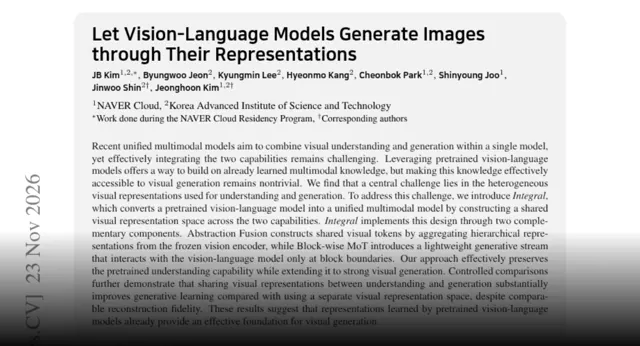
Integral: JB Kim and colleagues add image generation to pretrained vision-language models

Integral is a framework that turns a pretrained vision-language model into a unified model that can both understand and generate images. It builds a shared visual representation space for the two tasks. The authors report this preserves understanding ability and improves generative learning over a separate representation space.