Sources, 1 outlet
Baihan Yang et al. release PixelMatte, image matting with pixel-space diffusion transformers
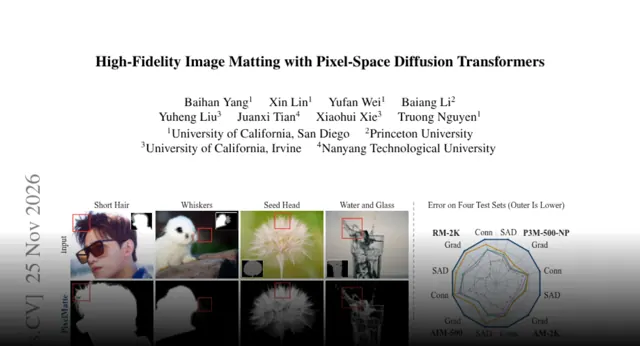
PixelMatte adapts pretrained pixel-space diffusion transformers to predict alpha mattes for image matting, avoiding the compression of latent diffusion models. It predicts mattes in a single forward pass and works even from a text-to-image-only backbone. The authors report 24-44% lower SAD and gradient errors than RenderMatte on P3M-500-NP.
Quick facts
| Authors | Baihan Yang, Xin Lin, Yufan Wei, Baiang Li, Yuheng Liu, Juanxi Tian, Xiaohui Xie, Truong Nguyen |
|---|---|
| Type | Research paper |
| Published | 2026-11-25 |
| Benchmarks | Four benchmarks, two pixel diffusion backbones |
| Error reduction | 24-44% in SAD and gradient vs RenderMatte on P3M-500-NP |
| Availability | Code, weights and demo linked |
What it is
PixelMatte is a framework for high-fidelity image matting, which means estimating the alpha matte that separates a foreground subject from its background. Existing diffusion-based matting methods mostly use latent diffusion, whose compressed representations and VAE reconstruction do not match the high-frequency precision matting needs. PixelMatte instead builds on pretrained pixel-space diffusion transformers.
How it works
It reuses the backbone's native patch embedding to process the input image, trimap and noisy alpha matte together as spatially aligned tokens, so no extra condition encoders or adapters are needed. Training uses pixel-accurate synthetic supervision followed by real-image fine-tuning, and the model outputs the alpha matte in one forward pass. Two lightweight modules, LayerShift and High-Pass Refiner, improve regional opacity accuracy and boundary fidelity.