Sources, 1 outlet
Arya Sikder releases Vernier, a tool for measuring resolution of time-series forecasting leaderboards
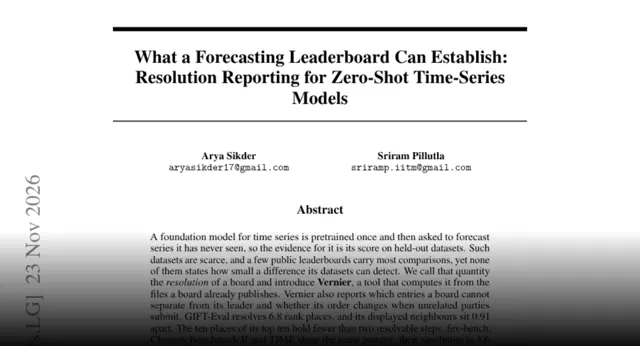
Vernier computes the resolution of a forecasting leaderboard, meaning the smallest score difference its datasets can detect, using files the board already publishes. It also reports which entries cannot be separated from the leader and whether rankings shift when other parties submit. It is aimed at people who rely on zero-shot time-series leaderboards.
Quick facts
| Author | Arya Sikder |
|---|---|
| Type | Paper and open tool |
| GIFT-Eval resolution | 6.8 rank places; neighbours 0.91 apart |
| Other boards | Resolution 3.6 to 19 times neighbour gap |
| BOOM | Only board resolving its top ten (2,554 series) |
| Ranking reversals | 43 top-ten pairs across four boards |
What it is
Vernier is a tool that reports how small a difference a time-series forecasting leaderboard can actually detect, a quantity the paper calls its resolution. Foundation models for time series are judged on held-out datasets, which are scarce, and public leaderboards rarely state how reliable their rankings are. The paper finds that GIFT-Eval, fev-bench, Chronos Benchmark II and TIME have resolution well above the gaps between neighbouring entries.
How it works
Vernier computes resolution from the per-dataset scores a leaderboard already publishes, and runs the full report with one command. It also identifies entries a board cannot separate from its leader and checks whether the order changes when unrelated parties submit. The authors fixed what counts as an independent source on each board before looking at scores.