Sources, 1 outlet
DocSEAM: cross-page encoding module for multi-page document VLMs, by Nguyen and Loy
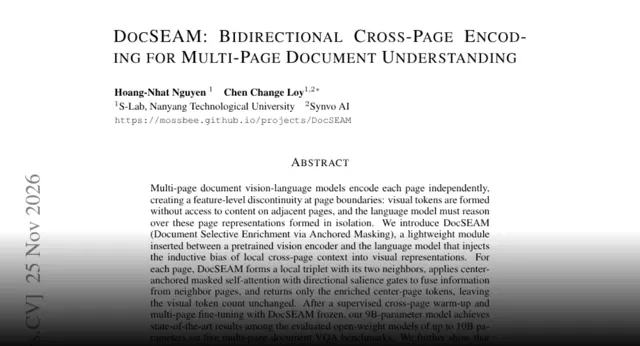
DocSEAM is a lightweight module placed between a pretrained vision encoder and the language model in multi-page document models. It lets each page's visual tokens draw on its two neighboring pages without increasing the visual token count. The authors report state-of-the-art results among evaluated open-weight models with a 9B-parameter model.
Quick facts
| Authors | Hoang-Nhat Nguyen, Chen Change Loy |
|---|---|
| Type | Research paper |
| Model size | 9B parameters |
| Visual token count | Unchanged |
| Published | Nov 25, 2026 |
What it is
DocSEAM (Document Selective Enrichment via Anchored Masking) addresses a weakness in multi-page document vision-language models. These models encode each page independently, so visual tokens are formed without seeing adjacent pages, creating a discontinuity at page boundaries. DocSEAM adds local cross-page context to the visual representations.
How it works
For each page, DocSEAM forms a local triplet with its two neighbors and applies center-anchored masked self-attention with directional salience gates to fuse neighbor information. It returns only the enriched center-page tokens, so the token count stays the same. Training uses a supervised cross-page warm-up, then multi-page fine-tuning with DocSEAM frozen.