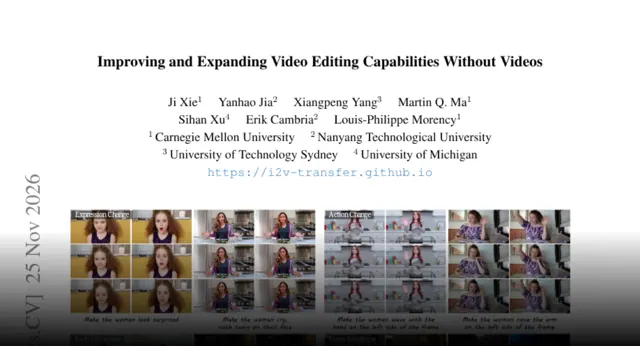
Ji Xie and coauthors release Image-to-Video Transfer (I2VT) for improving video editors
I2VT is a method that improves pretrained video editing models and extends them to new editing tasks using an image editor. It needs no architectural changes and no new videos, only individual images. It is aimed at researchers working on instruction-following video editing.
Quick facts
| Authors | Ji Xie, Yanhao Jia, Xiangpeng Yang, Martin Q. Ma, Sihan Xu, Erik Cambria, Louis-Philippe Morency |
|---|---|
| Type | Research paper |
| Training data | Individual images only, no new videos |
| Architecture changes | None |
| Availability | Fully open-sourced |
| Published | November 25, 2026 |
What it is
Image-to-Video Transfer (I2VT) is a way to bring the capabilities of image editing models to video editing models. Image editors follow a wide range of instructions, while video editors lag behind, partly because paired source and edited videos are hard to collect. I2VT improves existing video editors and lets them handle new editing tasks without that paired video data.
How it works
The approach rests on the idea that an image is a one-frame video, so good image editing can serve as a foundation for good video editing. An image editor is used to post-train a pretrained video editor efficiently. This requires no architectural changes and no new videos, using only individual images.