Sources, 1 outlet
HiGLR: efficient all-in-one image restoration network from Dongheon Lee and colleagues
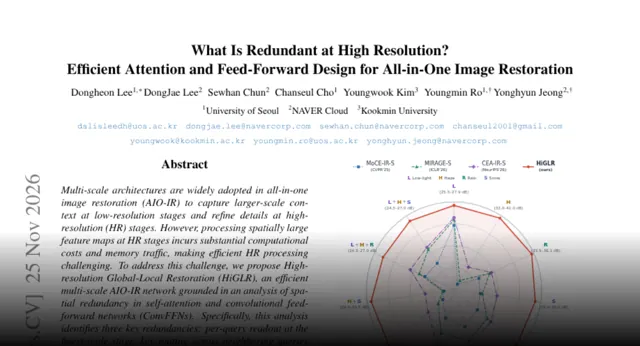
HiGLR is a 7M-parameter multi-scale network for all-in-one image restoration, built by cutting redundant computation at high resolution. It replaces or restructures self-attention and convolutional feed-forward layers in different stages. The authors report state-of-the-art results on three benchmarks with faster inference and lower peak GPU memory than CEA-IR-S.
Quick facts
| Authors | Dongheon Lee et al. (University of Seoul) |
|---|---|
| Parameters | 7M |
| Benchmarks | State-of-the-art on AIO-3, AIO-5, CDD-11 |
| Speedup | Up to 4.24× faster than CEA-IR-S |
| Memory | 65.8% lower peak GPU memory than CEA-IR-S |
| Code | github.com/dslisleedh/HiGLR |
What it is
HiGLR (High-resolution Global-Local Restoration) is an all-in-one image restoration model that handles multiple kinds of image degradation in one network. Multi-scale designs in this area spend heavy compute and memory on high-resolution feature maps. The paper analyzes which parts of that computation are redundant and builds a lighter model from the findings.
How it works
The analysis finds three redundancies. At the finest stage, self-attention is replaced with a learned, input-independent kernel. At intermediate stages, Block-Routed Hybrid Attention shares routing indices across neighboring queries and combines coarse dense attention with fine block-sparse attention over value residuals. A Dual-Space FFN does spatial mixing in a compact space and keeps the expanded part pointwise, which allows kernel fusion.