Sources, 1 outlet
FoundSurface: feed-forward 3D surface reconstruction from unposed images, from vLAR Group
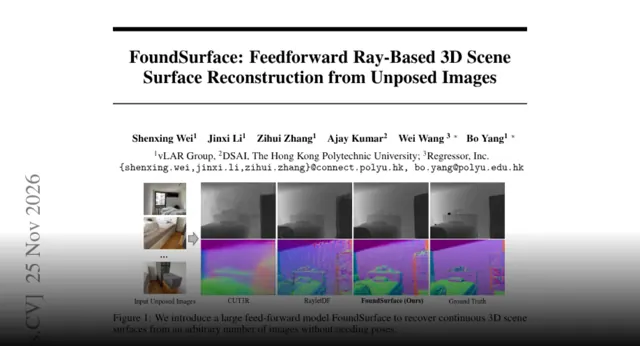
FoundSurface is a model that recovers continuous 3D scene surfaces from unposed images in a single feed-forward pass. For each pixel of a target view it predicts the distance travelled by the ray, from which surfaces and analytical normals follow. It was trained on 9 datasets and tested zero-shot on 6 unseen ones.
Quick facts
| Authors | Shenxing Wei, Jinxi Li, Zihui Zhang, Ajay Kumar, Wei Wang, Bo Yang |
|---|---|
| Group | vLAR Group, HK PolyU |
| Training data | 9 diverse large-scale datasets |
| Zero-shot evaluation | 6 unseen datasets |
| Venue | NeurIPS'26 |
| Code | Available on GitHub (vLAR-group/FoundSurface) |
What it is
FoundSurface is a foundation model for 3D surface reconstruction from images without known camera poses. Pointmap methods that skip camera poses produce discrete, sparse outputs. FoundSurface instead aims to give continuous, high-fidelity surfaces.
How it works
A pre-trained pointmap model first extracts geometric priors. A query-view-centric selection module picks relevant reference views through surfel voting, and a cross-attention regressor links target query rays to reference features to estimate a coarse continuous surface. A raylet-based module then aggregates local 3D features to add fine detail and analytical normals, using a per-pixel ray-distance field.