Sources, 1 outlet
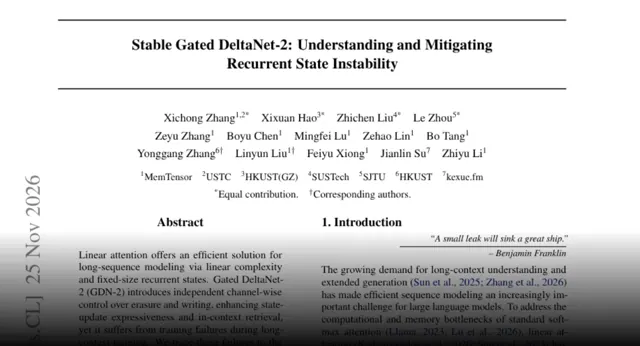
Stable Gated DeltaNet-2: Xichong Zhang et al. fix recurrent state instability in linear attention
Stable GDN-2 is a modification of Gated DeltaNet-2 that addresses training failures in long-context linear attention models. It uses symmetric erasure and decay-regulated residual writing to keep the recurrent state from growing exponentially. On ~1.6B parameter models it trains stably and improves long-context retrieval.
Quick facts
| Authors | Xichong Zhang et al. |
|---|---|
| Model scale tested | ~1.6B parameters |
| State growth bound | O(√T) |
| 128K RULER (recurrent) | +6.80 points vs GDN-2 |
| Nine downstream tasks (hybrid) | +0.62 points average accuracy |
What it is
Stable GDN-2 is a linear attention design that builds on Gated DeltaNet-2, which controls erasing and writing independently per channel. GDN-2 improves in-context retrieval but suffers training failures during long-context training. Stable GDN-2 targets those failures so the model trains reliably on long sequences.
How it works
The authors trace the failures to an asymmetry between reading and modification directions during erasure. This produces non-normal erase operators whose gains accumulate across tokens and cause exponential state growth even without new writes. Stable GDN-2 uses symmetric erasure to keep state propagation non-expansive and decay-regulated residual writing to preserve writing flexibility. The paper proves an O(√T) upper bound on state growth while keeping chunkwise parallel computation.