Sources, 1 outlet
HOG-WAM: Boxuan Dong et al. add future-gradient prediction to world-action models
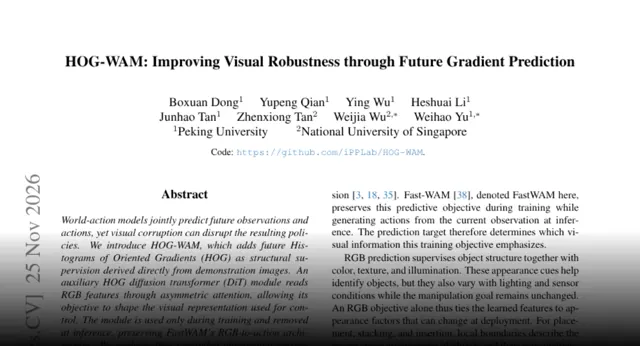
HOG-WAM adds future Histograms of Oriented Gradients as extra training supervision for world-action robot policies, aiming to make them more robust to visual corruption. The auxiliary module is removed at inference, so the RGB-to-action model is unchanged. It reports higher success under corrupted observations on RoboTwin-Plus, LIBERO Plus and real Franka tasks.
Quick facts
| Authors | Boxuan Dong et al. (intelligence++) |
|---|---|
| Base model | FastWAM |
| RoboTwin-Plus mixed noise | 78.86% to 82.86% |
| LIBERO Plus overall | 74.49% to 75.26% |
| Franka tasks, clean | 40% to 59% |
| Code | github.com/iPPLab/HOG-WAM |
What it is
HOG-WAM is a training method for world-action models, which jointly predict future observations and robot actions. These policies can fail when camera images are corrupted, for example by sensor noise. HOG-WAM aims to make the learned visual representation hold up better under such corruption.
How it works
An auxiliary HOG diffusion transformer predicts future Histograms of Oriented Gradients, computed directly from demonstration images. It reads RGB features through asymmetric attention, so its objective shapes the visual representation used for control. The module is used only during training and dropped at inference, which keeps FastWAM's RGB-to-action architecture. An ablation found that combining RGB with HOG prediction works better than replacing RGB with HOG.