Tagged multimodal

Multimodal AI models process or produce more than one type of data, such as text, images, audio, and video, within a single system. More in Learn

Dataset

Google DeepMind releases Multimodal Knowledge Agent benchmark with 10 showcase tasks

Multimodal Knowledge Agent (MKA) is a benchmark for testing AI agents on multi-step professional work that depends on visual files such as CAD blueprints, schematics, and geospatial rasters. This release contains 10 showcase tasks across 10 domains, each with input files and grading rubrics. It is aimed at evaluating agents that must perceive images, use tools, and produce deliverables.


Paper

EgoUseBench: Yurun Chen et al. release a benchmark for computer-use agents with first-person context

EgoUseBench tests whether computer-use agents can act on tasks grounded in first-person views from wearables like smart glasses, as the user's intent and observations change. It has 693 tasks built from over 74 hours of real-world first-person recordings. Average success in the Online Ego Use setting is 26.3% lower than in standard Computer-Use.

Paper

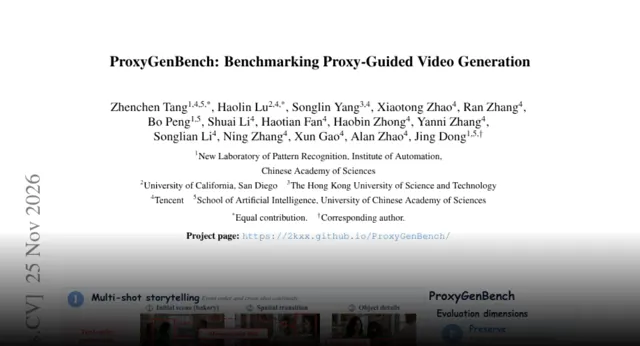
ProxyGenBench: a benchmark for proxy-guided video generation, from Zhenchen Tang et al.

ProxyGenBench is a benchmark that tests how well video generators follow structural proxies such as animated 3D blockouts. It has 312 evaluation cases from 60 scenes, with controlled changes in proxy fidelity, text detail and multimodal inputs. Tests on five generators show proxies improve spatiotemporal control, but strong structural adherence does not ensure correct binding.

Paper

DocSEAM: cross-page encoding module for multi-page document VLMs, by Nguyen and Loy

DocSEAM is a lightweight module placed between a pretrained vision encoder and the language model in multi-page document models. It lets each page's visual tokens draw on its two neighboring pages without increasing the visual token count. The authors report state-of-the-art results among evaluated open-weight models with a 9B-parameter model.

Paper

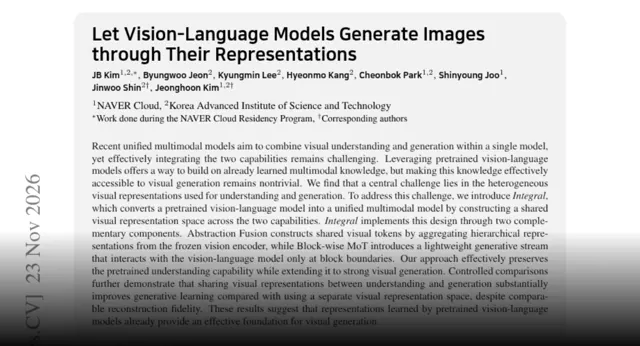
Integral: JB Kim and colleagues add image generation to pretrained vision-language models

Integral is a framework that turns a pretrained vision-language model into a unified model that can both understand and generate images. It builds a shared visual representation space for the two tasks. The authors report this preserves understanding ability and improves generative learning over a separate representation space.