What AI shipped

31 in the last 24 hours, from the primary sources, refreshed every two hours

Model 19Tool 6Paper 2Dataset 10Benchmark 5Security 2Video 3
Dataset

Google DeepMind releases Multimodal Knowledge Agent benchmark with 10 showcase tasks

Multimodal Knowledge Agent (MKA) is a benchmark for testing AI agents on multi-step professional work that depends on visual files such as CAD blueprints, schematics, and geospatial rasters. This release contains 10 showcase tasks across 10 domains, each with input files and grading rubrics. It is aimed at evaluating agents that must perceive images, use tools, and produce deliverables.


Benchmark

yurun-chen releases EgoUseBench, a benchmark for computer-use agents in first-person contexts

EgoUseBench is a benchmark for computer-use agents operating under evolving first-person contexts. It has 200 base tasks shared across Computer-Use, Offline Ego Use, and Online Ego Use settings, plus 93 composite online tasks. The repository provides task definitions and sampled frames for researchers evaluating such agents.

Toolmajor

ggml-org releases llama.cpp 1.0 and ggml 1.0 for running language models locally

llama.cpp, the open source C/C++ package for running AI language models on local machines, has reached version 1.0 after more than three years. The release adds support for new models including Kimi-K3.1 Pro, text-to-speech in the built-in server, and a redesigned chat interface. It is aimed at anyone running models on laptops, servers, or edge hardware.

Paper

Stable Gated DeltaNet-2: Xichong Zhang et al. fix recurrent state instability in linear attention

Stable GDN-2 is a modification of Gated DeltaNet-2 that addresses training failures in long-context linear attention models. It uses symmetric erasure and decay-regulated residual writing to keep the recurrent state from growing exponentially. On ~1.6B parameter models it trains stably and improves long-context retrieval.

Benchmark

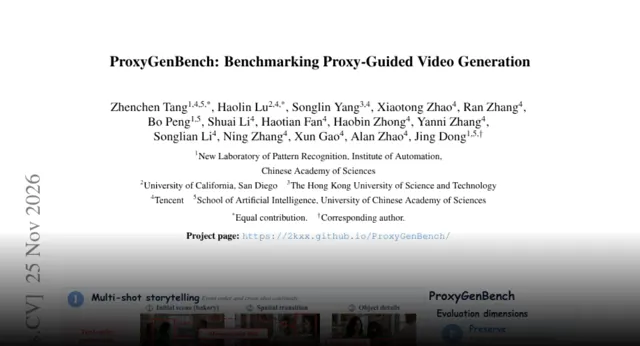
ProxyGenBench: a benchmark for proxy-guided video generation, from Zhenchen Tang et al.

ProxyGenBench is a benchmark that tests how well video generators follow structural proxies such as animated 3D blockouts. It has 312 evaluation cases from 60 scenes, with controlled changes in proxy fidelity, text detail and multimodal inputs. Tests on five generators show proxies improve spatiotemporal control, but strong structural adherence does not ensure correct binding.

Paper

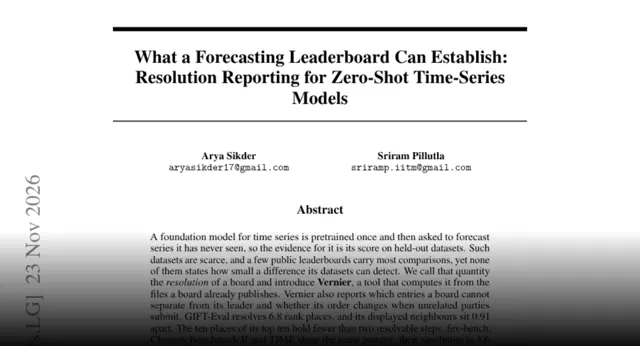
Arya Sikder releases Vernier, a tool for measuring resolution of time-series forecasting leaderboards

Vernier computes the resolution of a forecasting leaderboard, meaning the smallest score difference its datasets can detect, using files the board already publishes. It also reports which entries cannot be separated from the leader and whether rankings shift when other parties submit. It is aimed at people who rely on zero-shot time-series leaderboards.