Benchmark

A standardized test set and scoring method used to measure and compare how well AI models perform on a defined task.

What it is

A benchmark is a fixed collection of tasks, inputs and scoring rules designed to evaluate a model's abilities in a repeatable way. It can cover anything from question answering and coding to robot manipulation or tool use. Results are usually reported as a score that can be compared across models.

Why it matters

Benchmarks give builders and users a common yardstick for choosing between models and tracking progress over time. They also reveal weaknesses that a general impression of a model might hide. However, scores can mislead if a benchmark is too narrow, leaks into training data, or no longer reflects real use.

How it works

Creators assemble tasks with known correct answers or rating criteria, sometimes using human annotators or synthetic data. Models are run on the same inputs under the same conditions, and outputs are scored automatically, by human judges, or by another model. Scores are then aggregated into metrics and often published on leaderboards with the dataset and evaluation code so others can reproduce them.

Releases tagged benchmark

Dataset

Google DeepMind releases Multimodal Knowledge Agent benchmark with 10 showcase tasks

Multimodal Knowledge Agent (MKA) is a benchmark for testing AI agents on multi-step professional work that depends on visual files such as CAD blueprints, schematics, and geospatial rasters. This release contains 10 showcase tasks across 10 domains, each with input files and grading rubrics. It is aimed at evaluating agents that must perceive images, use tools, and produce deliverables.

Paper

EgoUseBench: Yurun Chen et al. release a benchmark for computer-use agents with first-person context

EgoUseBench tests whether computer-use agents can act on tasks grounded in first-person views from wearables like smart glasses, as the user's intent and observations change. It has 693 tasks built from over 74 hours of real-world first-person recordings. Average success in the Online Ego Use setting is 26.3% lower than in standard Computer-Use.

Paper

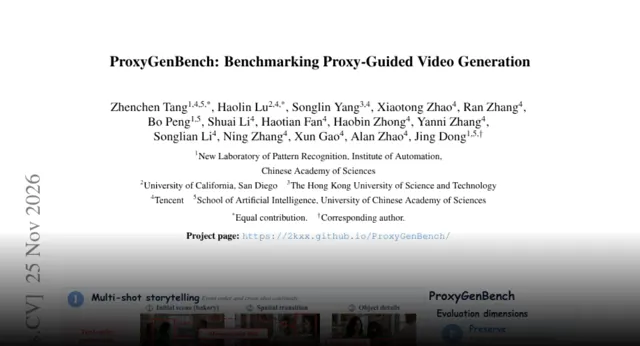
ProxyGenBench: a benchmark for proxy-guided video generation, from Zhenchen Tang et al.

ProxyGenBench is a benchmark that tests how well video generators follow structural proxies such as animated 3D blockouts. It has 312 evaluation cases from 60 scenes, with controlled changes in proxy fidelity, text detail and multimodal inputs. Tests on five generators show proxies improve spatiotemporal control, but strong structural adherence does not ensure correct binding.

Paper

Arya Sikder releases Vernier, a tool for measuring resolution of time-series forecasting leaderboards

Vernier computes the resolution of a forecasting leaderboard, meaning the smallest score difference its datasets can detect, using files the board already publishes. It also reports which entries cannot be separated from the leader and whether rankings shift when other parties submit. It is aimed at people who rely on zero-shot time-series leaderboards.

Paper

AIRIS: Yuchen Zhou et al. release streaming benchmark for social embodied intelligence

AIRIS is a benchmark that tests how models handle social situations in egocentric streaming video, where they see only the footage available at each query time. It frames the task as a chain of Attention, Intention, Reaction, and Interaction. Tests of 45 models show they often guess intent too early and struggle to align timing, action, and execution.

Paper

Real2SimLab: unified platform for real-to-simulation transfer, from Yongchang Zhang et al.

Real2SimLab is a platform for evaluating methods that build simulations from real-world observations such as video recordings. Existing benchmarks each define their own inputs, deliverables and scoring, so testing N methods on M benchmarks needs N times M integrations. Real2SimLab is meant to unify this for researchers working on real-to-simulation transfer.